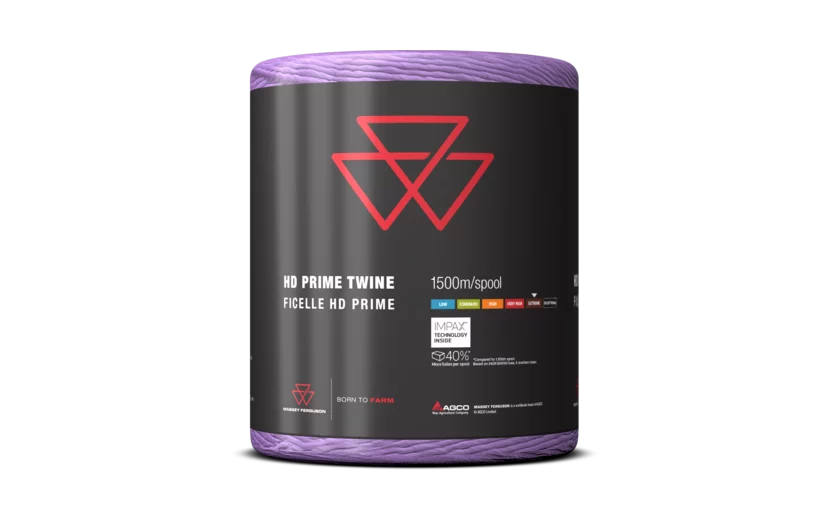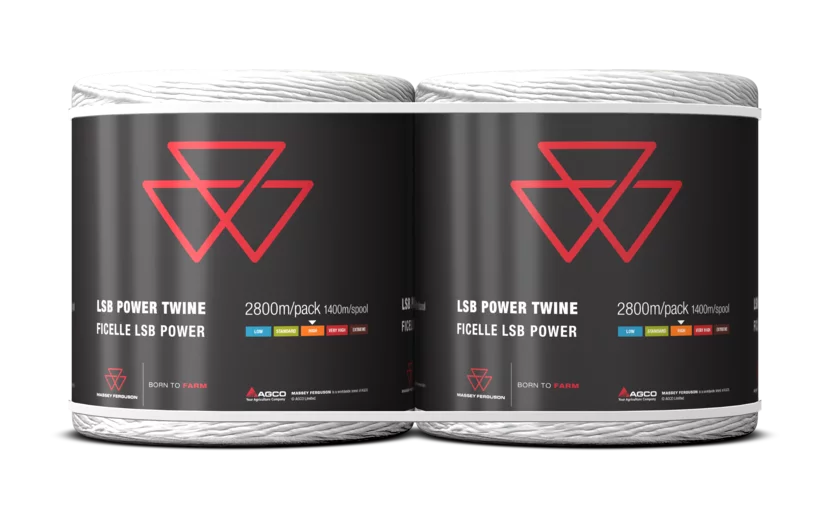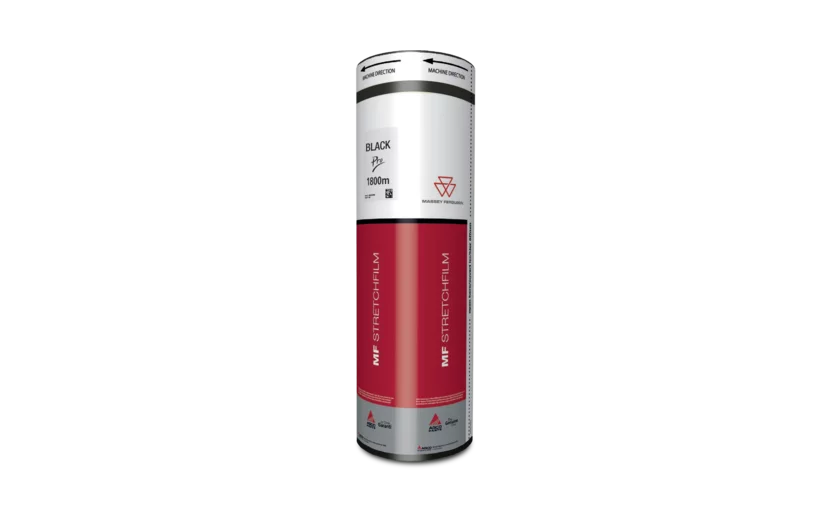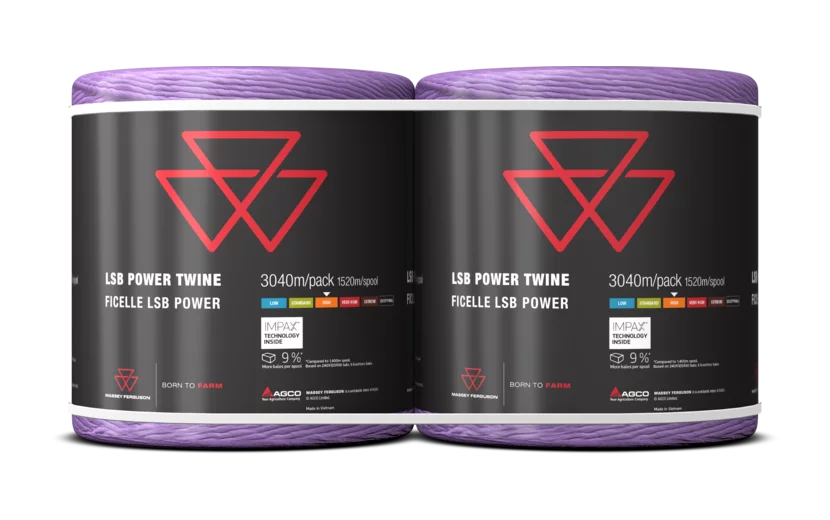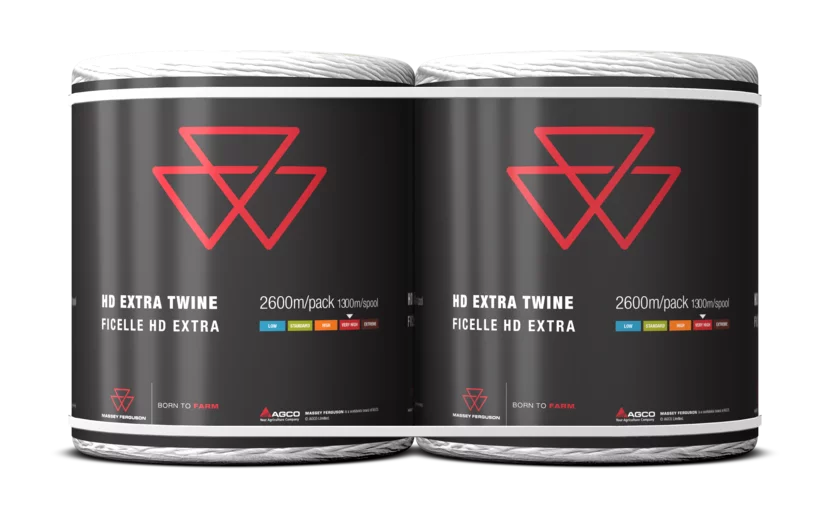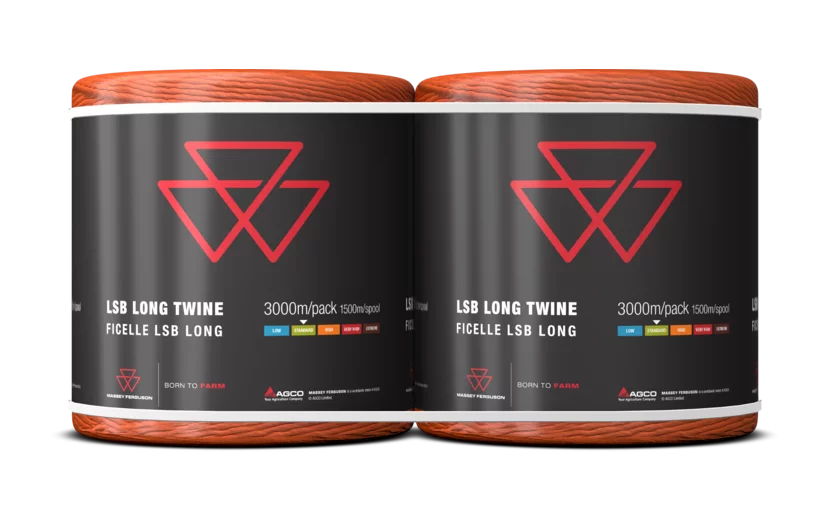
Massey Ferguson IMPAX HD Prime Twine

Length:
1,500 M

It begins with superb twine. Massey Ferguson IMPAX® HD Prime offers a unique combination of unprecedented length with incredible workability even with the highest densities, toughest crops and most extreme weather conditions. Now you can bale longer with confidence.
Massey Ferguson Twine Impax Hd Prime 1500 M Spool Violet

Features & Benefits

Light, strong and reliable

IMPAX® technology allows the production of twine that is Low-weight, thinner and still can cope with any baling condition, baler density and type of crop.

Longer than ever

Incredible length for a non-stop and trouble-free baling day

Shock absorption

IMPAX® technology decreases the impact on the bale to keep the knots firm and strong.

Superiore knot performance

The thinner knots achieved with IMPAX® technology prevent slips and allow superior knotting bale after bale.

Guaranteed Spool Length

Each spool contains the stated length for better on-field performance.

Knot integrity

Holds all the tension applied when baling with extreme density.

Durable

Excellent strength and longevity during bale transit and storage.

Globally tested

3,000,000 bales with IMPAX® technology were tested globally with great success with all types of crops and conditions.

UV Protection

UV light inhibitors can withstand intense exposure over long periods.
Extreme density Icon

Extreme density

Suitable for making extreme density bales in extreme conditions.

Technical support

Get the assistance you need to achieve the best result with expert technical support available wherever you are and whenever you need it.

Selection made simple

All Massey Ferguson twines are colour coded so you can quickly see and choose the best twine for your baler, crop and conditions.

Technologies

Specifications

1 Products


Results (7)
Results (7)
R&D Management CTO Reuven Hugi
As a global company that operates worldwide and in different climates, we must bring the best and most innovative products with excellent...
Reuven
Regional Sales Manager Ed Leggett
Ed has been involved in agriculture for over a decade, originally at dealerships and now in his role as the Sales Manager...
Ed
Territory Sales Manager Alastair Thomson
Alastair covers the entire Scottish region and parts of Northern England and has been at Tama for over five years.
Alastair
Territory Sales Manager Andy Lanczak
Andy was originally in charge of the Tama UK manufacturing facility and is now looking after customers in the North East and...
Andy
Commercial Manager Warren Tatton
Warren has worked at Tama for 20 years and is now responsible for the day to day management of Tama UK, taking...
Warren
Territory Sales Manager Martin Andrews
Martin lives in Gloucestershire and has spent many years in agricultural retail after starting as a General Manager of an agricultural store...
Martin
Territory Sales Manager & Sales Company Technical Manager Jonathan Coleclough
Jonathan is responsible for product knowledge & training within Tama UK, as well has covering the Midlands and East of England as...
Jonathan

More ways we can assist

Service request Icon

Service request

Knowledge Centre Icon

Knowledge Centre

Training Icon

Training

Field experts Icon

Field experts

Twine?

Twine Baling Tips
Large Square Baling
Very careful attention should be paid to the bale pressure, depending on the type and condition of the crop being baled. During periods of extended dry and hot weather, for instance, straw bales may be noticeably lighter than during normal conditions, with the baler set to the same bale pressure setting.
In these circumstances, a decrease in pressure setting will overcome this; or, alternatively, a move to the next heavier twine is recommended.
For baling good quality large square silage bales, it is important to follow a few simple guidelines:

Ensure the crop has wilted to a minimum of 40 – 50% dry matter (DM), which will produce well-formed bales as well as excellent fermentation.
Ensure the twine box tension is reduced as much as possible, as twine friction experienced between silage bales during baling is much greater than between straw bales.
Eliminate as much air as possible from the crop when baling, as it is essential that sufficient crop is packed into the top of the bale to avoid misshapen bales being formed, which may be difficult for an automatic bale-wrapper to handle properly. A reduction in forward speed will help to achieve this by increasing the number of wads per bale.
Skip to content